
Fractional CMO
Forward Deployment Operator

There is an undercurrent of anxiety in GTM teams heading into 2027. Leaders know they need to figure out how to leverage AI, and there is a growing fear that waiting too long will create a competitive disadvantage.
The problem is not a lack of ideas. Most GTM leaders can already imagine the use cases. The problem is that they are unsure where to start, which capabilities are real, which are smoke and mirrors, and whether the systems they already have are ready to support any of it.
That last question is the one I think we are underestimating.
We have spent 20 years adding data. We have not spent 20 years making it usable.
For twenty years, GTM teams have solved complexity by adding to it. Add another field. Build another workflow. Connect another platform. Capture another data point because someday we might use it for personalization.
We got very good at collecting information. We were much less disciplined about preserving the context behind how that information should be interpreted and used.
Humans filled in the gaps. They knew which fields mattered, which exceptions applied, when one signal should outweigh another, and when the rules changed based on the customer or situation. Much of that judgment never made it into the system.
That was manageable when humans were making most of the decisions.
It becomes a very different problem when we ask AI to make decisions using that information.
McKinsey’s 2026 research captures part of this gap. Seventy percent of respondents said they felt personally prepared to adopt and use AI, while only 27 percent of leaders believed their organizations were ready to make the shifts required for an agentic future.
The constraint is not simply access to AI. It is whether the organization has enough clarity to use it well.
I have seen teams experiment with LLMs to dynamically select content for different email segments. The technology can absolutely do it. That is not the hard part.
The hard part is whether the content library has been cleaned, whether assets are categorized consistently, whether the segmentation strategy is actually agreed upon, and whether the business has made its decision logic explicit.
Segmentation itself is rarely one-dimensional. Industry, use case, product fit, lifecycle stage, behavior, customer value, and other signals may all matter. The challenge is deciding which combination matters most in a given situation, which signal takes priority, and when an exception should override the rule.
A human building the audience may know that logic instinctively because it has become institutional knowledge over time.
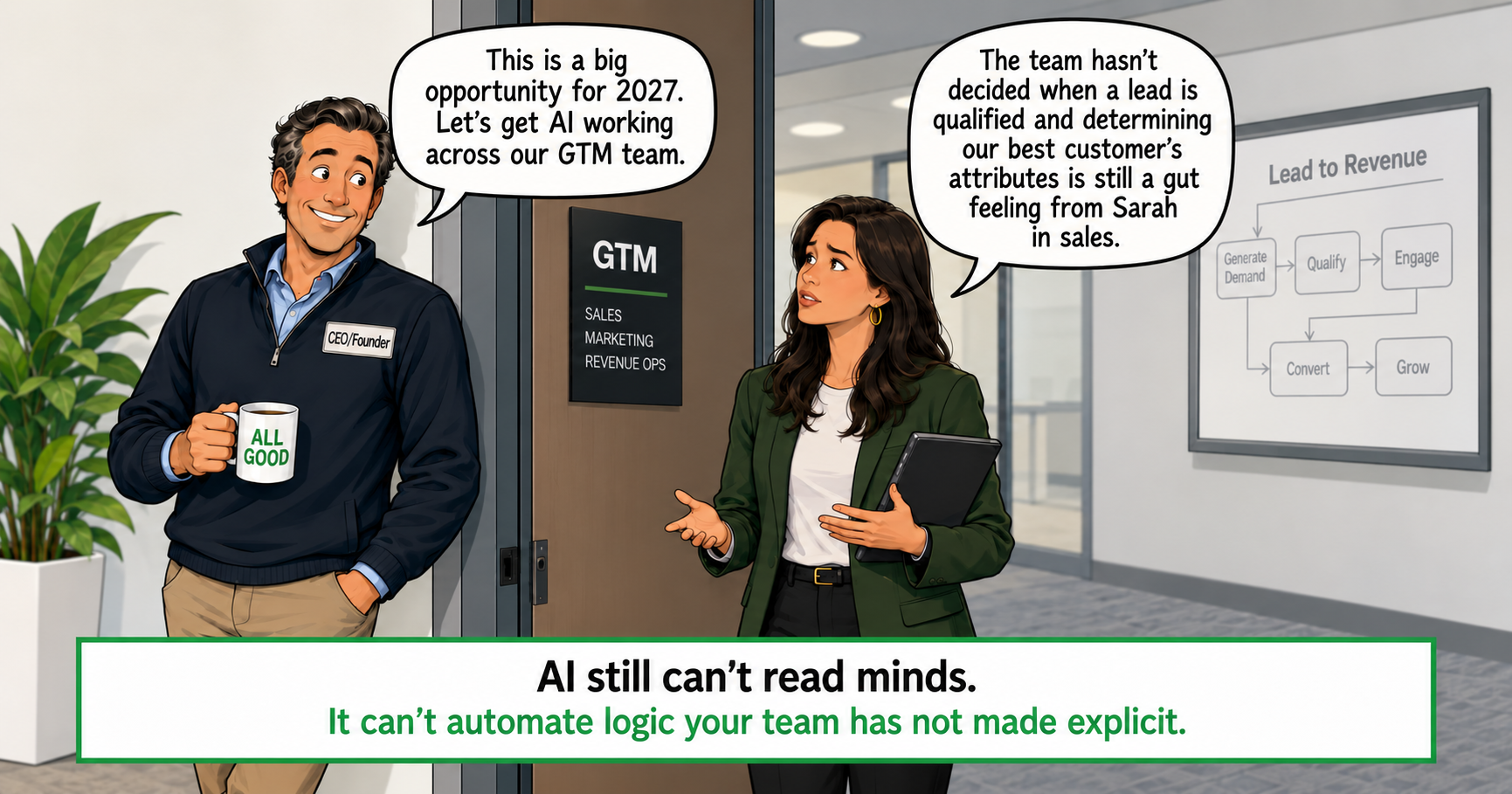
Humans have been carrying the logic. AI needs that logic made explicit, and then it inherits whatever version of the truth you give it.
The same problem shows up across the revenue lifecycle.
If Sales and Marketing have different definitions of “qualified,” AI does not settle the disagreement. It scales whichever definition it has been given.
If the business has not aligned on which customers create the strongest lifetime value, AI can help you find more customers that fit the wrong profile.
If stage definitions are unreliable, an AI-assisted forecast may look more sophisticated without becoming more accurate.
Bad data and an unclear GTM strategy do not become less dangerous with AI. They become easier to scale.
This does not mean companies should wait until their data environment is perfect. That would create a different problem.
The better approach is to narrow the use case. Pick one meaningful business problem. Decide what good looks like. Identify the data and decision logic required to solve it. Clean what matters for that use case, test it, and learn.
You do not have to fix the entire GTM system before using AI. You do have to understand the part of the system you are asking AI to improve.
That is also where the research gets interesting.
McKinsey found that leaders were 5.3 times more likely to report enterprise value capture when workflows were redesigned than when they remained unchanged, 32 percent compared with 6 percent.
Deloitte’s 2026 State of AI in the Enterprise found that only 30 percent of organizations were redesigning key processes around AI, while 37 percent were using AI at a surface level with little or no change to underlying processes.
For a GTM organization, I would want alignment on a handful of fundamentals before aggressively automating decisions: the ICP, what “qualified” means, how leads and accounts move through the lifecycle, how customer value is measured, which data can be trusted, what point of view the company wants reflected in the market, and which business outcome the AI is supposed to improve.
That does not require perfection.
It requires a team willing to question processes that may have been built for a completely different era of GTM.
The companies most at risk are not necessarily the ones moving slowly on AI.
They are the ones taking a twenty-year-old data structure and GTM motion, layering automation on top of it, and assuming intelligence will emerge.
They will forecast from the wrong signals faster. Send the wrong message to the right customer more efficiently. Automate cross-functional disagreements. Continue winning customers that cost them margin.
AI will not fix those problems. It will make them harder to ignore.
The companies that get the most value from AI will be the ones willing to make the decision logic explicit, align on what good looks like, and give AI enough context to accelerate the right things.
The advantage will not come from automating more. It will come from knowing what is worth automating in the first place.