The CMO Hire Was Built for Cheap Capital. That Assumption Just Broke.

The Old Model Just Got Expensive
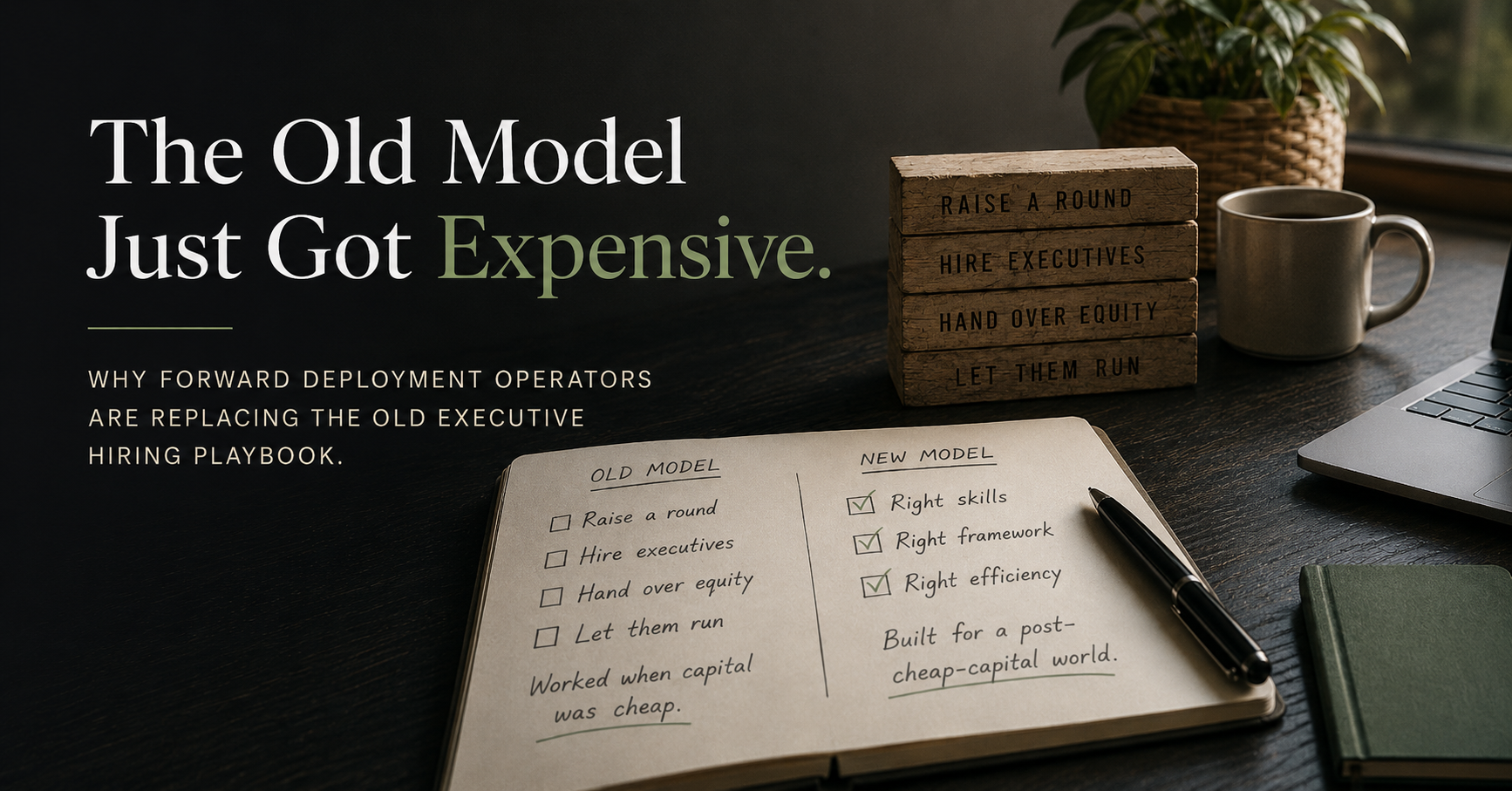
For the last two decades, scaling from $10M to $100M ran on one formula: raise a round, hire executives who'd done it before, hand them equity, and let them run. Couldn't afford a $400K CMO? Raise a round, promise the upside, bring in the talent anyway. The playbook worked because capital was cheap enough to cover the gap between what a company needed and what it could pay for outright.
Capital still covers that gap. It's just not cheap anymore, and that's what's breaking the old model. Raising a round to fund a bet on an executive now costs more dilution, more scrutiny, and harder terms than it did five years ago. Growth used to be able to outrun inefficiency. Now efficiency is the constraint growth has to run inside of. Two things are pulling the old hiring model apart at the same time.
Two Forces Breaking It, Skill Function and Framework Gaps
AI is transforming every GTM function, including marketing, sales, and customer success. But that transformation runs through experienced people who know what to do with the tools, not people who just know how to operate them. Sangram Vajre, CEO of GTM Partners, put it plainly in a recent LinkedIn post: "you don't need more soldiers. you need navy seals." An org built to manage headcount and delegate execution isn't the org built to run that kind of transformation.
At the same time, frameworks are beating playbooks. A personal playbook, built from one executive's own career, has to start the diagnosis from scratch every time it lands in a new company. A framework doesn't. It's why the GTM Operating System's eight pillars exist: a repeatable way to find where the go-to-market motion is actually breaking, before you commit budget to fixing the wrong thing.
What are Forward Deployment Operators
Vajre's answer to both shifts is what he's calling the Forward Deployment Operator, FDO for short: a GTM transformation expert who embeds inside the team and does the work, rather than advising from outside the org chart or joining as a full-time bet that a company hopes pays off eventually. And it's worth being precise about what FDO actually replaces. Most CEOs already know fractional leadership exists. The real shift isn't fractional versus full-time, it's what kind of fractional you're hiring.
| Traditional fractional executive | Forward Deployment Operator | |
|---|---|---|
| Mandate | Runs one function, marketing or sales, as a temporary department head | Works the cross-functional revenue engine, especially the handoffs between sales, marketing, and customer success |
| Diagnosis | Diagnoses from a personal playbook, built fresh in every engagement | Deploys the GTM OS's pillars and diagnostic questions from day one using a repeatable and scalable framework on the first day. |
| How the work gets done | Advises at the strategy level and hands execution to internal staff | Builds directly: logs into the tools, does the work, stays until the metric moves |
| Built for | Extended ramp, analysis, and testing time. Legacy org design, human bandwidth as the constraint | A post-cheap-capital economy, with AI doing real work inside the engagement |
The diagnosis row matters most. A fractional executive without a shared framework has to rebuild the diagnostic from zero, on your dime, before they can tell you anything you didn't already suspect. An FDO walks in with the framework already built. Week one gets specific fast: which of the eight pillars is breaking, and what to do about it.
Where Forward Deployment Operators Are Already Running
GTM Partners says it now has more than 150 GTM OS Certified Partners and just announced GTMarketplace, a curated bench of Forward Deployment Operators for CEOs who want this kind of talent without raising another round. I'm one of those certified partners. The Fractional CMO and GTM OS Pillar Strategy I use with clients already follow this order: diagnose against the eight pillars first, embed with the team second, leave a system behind third, so the client isn't dependent on me staying to keep it running.
The market shifted the funding math. The talent model was always going to follow. The only real question left is whether your next GTM hire gets built for the world where capital was cheap, or the one you're actually operating in.